

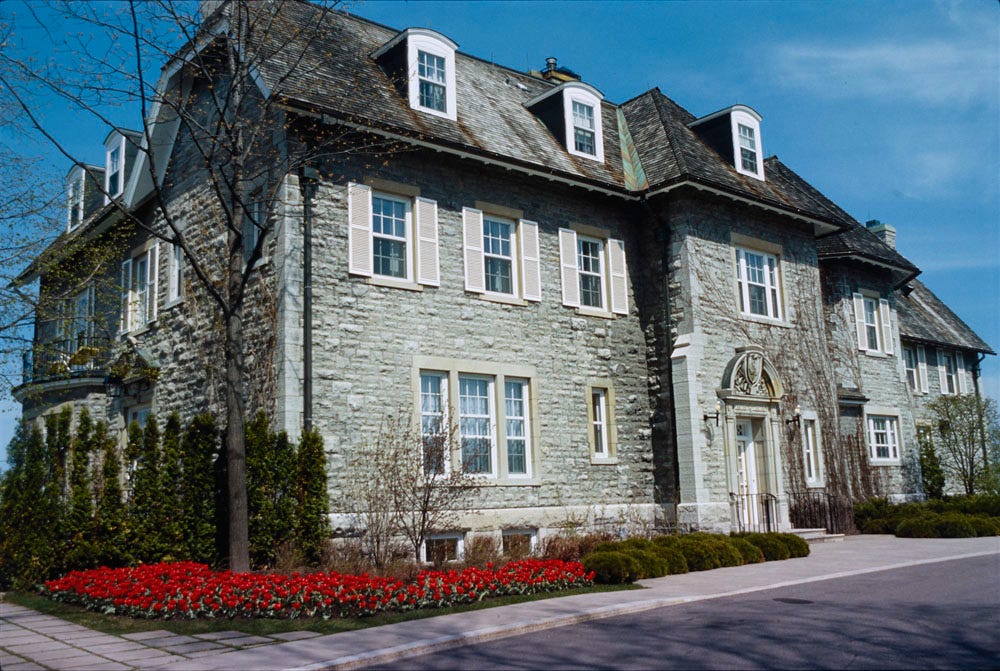
Prime Minister Mark Carney has finally charted a course out of the morass that is 24 Sussex Drive, the official residence of Canada’s prime ministers since 1951.
Carney’s June announcement of a private-sector competition to “modernize” the decrepit building, abandoned in 2015 and later put into mothballs, was welcomed by heritage advocates as an end to a political impasse. A winning design is to be announced Canada Day, July 1.
But will the Carney solution itself become a threat to the future of 24 Sussex?
The prime minister gave no hint about what the property might look like at the end of the process – and not a word about final cost – supposedly to avoid hamstringing proposals from the private sector.
With no guardrails, the coming competition could produce designs that overload the four-acre property with outbuildings, such as offices or a ballroom. The residence might get a major makeover that smothers historic elements beneath a grand architectural scheme. Perhaps only the facade will survive.
Any of these solutions would be an assault on the rich heritage of the existing building, and on its magnificent location overlooking the Ottawa River and the Gatineau Hills beyond. The historic structure might be saved from the wrecking ball, only to succumb to a zeal for creating a stunning landmark.
Two former prime ministers who lived and worked there came forward in 2024 with a non-partisan solution to end the embarrassment of 24 Sussex Drive. Jean Chretien and Stephen Harper together offered to raise private-sector funds to pay for basic repairs and upgrades, nothing major.
Their fundraising target was a modest $20 million. That’s a fraction of the $50 million the Carney government now is trying to raise through a crowdfunding appeal overseen by the Rideau Hall Foundation, an amount likely to be supplemented with public dollars.
Chretien and Harper, whose proposal was rejected by then-prime minister Justin Trudeau, found the existing layout of the house perfectly functional, enough space for family life and for entertaining visitors. Neither griped about the lack of a ballroom, or a pastry kitchen, or office space for aides.
Venues to host large groups are already available across the street at Rideau Hall, or down Sussex Drive at the Global Affairs Canada building, or at the National Arts Centre, or in the Sir John A. Macdonald Building on Wellington Street, or at the Museum of History in Gatineau, Que.
And in any case, the intimate spaces at 24 Sussex Drive have served a purpose, facilitating frank exchanges with foreign leaders and others. Paul Martin Jr. famously hammered out a health-funding deal with the premiers over five gruelling days at the residence in 2004, the evening sessions fuelled by pizza deliveries.
Carney’s new plan must also accommodate infrastructure to harden the residence against drones, snipers and other threats. Past proposals from the RCMP have estimated the security bill for the site at more than $50 million. Whatever the final cost, the prime minister says the amount will be paid entirely by taxpayers.
Security protection at the residence is a sine qua non for modernization. But when combined with the lofty aspirations of architects, the result could be a designer fortress – much different from the modest home that worked well for Canada’s prime ministers, notwithstanding a leaky roof and poor temperature control.
The worry is that the Carney process will take on unwanted momentum. Architects may raise the stakes, valuing ambitious visual statements over preservation of the past. Moshe Safdie, who heads the panel that will judge the winning design, recently put his thumb on the scale, telling the Globe and Mail that at the very least there is a need for a separate building on the site to accommodate social events held by the prime minister. This claim is not at all self-evident, and may inflate the expectations of competitors.
Canadians were proud of the stately building when it was unveiled in 1951, following Public Works’ makeover of a shabby timber-baron mansion. Opposition critics, editorialists and ordinary citizens saw in the residence an emblem of Canada’s new stature in the post-war world, as a victor nation in the Second World War, and a founding member of the United Nations and NATO.
For the last quarter century, though, 24 Sussex Drive has become a source of division as the building crumbled for lack of basic maintenance, and as politicians fretted about spending on needed repairs for fear of voter blowback.
Carney’s modernization plan for the official residence reflects a renewed Canadian patriotism in the face of existential threats from south of the border. But going grand at 24 Sussex Drive is overreach. The modest building unveiled in 1951 was a uniquely Canadian solution to housing our prime ministers, none of whom have ever agitated for more spacious accommodations. Proposing something more palatial now risks slipping back into political deadlock over the property’s future.
Restore the dignified, understated home that has ably served prime ministers since the middle of the last century. Spare the country another endless debate about extravagance, profligacy and pampered leaders. And show respect for the vibrant history that unfolded inside the unassuming walls of 24 Sussex Drive by preserving, not aggrandizing.
Dean Beeby is co-author, with Ian Bailey, of 24 Sussex Drive: The Past and Future of Canada’s Official Residence, to be published Oct. 20 by Sutherland House.
Nicely done. I've pre-ordered the book