
Indigenous groups call for community awards in Order of Canada
Only individuals are currently eligible for Canada's top civilian honour

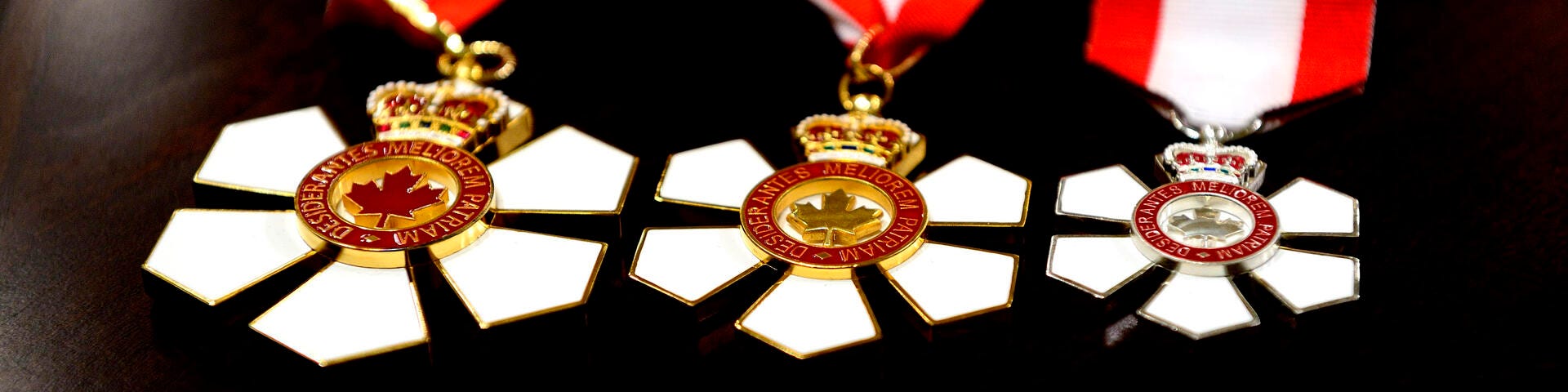
A project to ensure Order of Canada recipients better reflect Canada’s diversity appears to have hit a cultural barrier that could limit Indigenous participation.
Feedback from Indigenous groups suggests many are suspicious of the award’s “deep colonial symbolism,” and accepting it may bring “feelings of discomfort or shame.”
And some Indigenous organizations who were consulted say group achievement is much more important than that of individuals selected for the award.
“Indigenous perspectives often privilege honouring the contributions of communities as a whole, where community and collective impact matter more than individual distinction,” says an internal summary.
“Participants suggested that community-driven nominations could help decolonize and shift the focus away from government authority and toward the recognition of the community itself …”
The Order of Canada, created in 1967, is structured to recognize individual achievement and cannot be awarded to groups or communities. Any group seeking such recognition can do so only by nominating each individual within the community separately, an elaborate process that in the end does not recognize the group itself.
Documents outlining the diversity program were obtained from the Privy Council Office (PCO) under the Access to Information Act. A copy of the full release package can be downloaded here:

PCO declined to answer specific questions about the structural impediment, issuing a statement that said it continues to consult with First Nation, Metis and Inuit individuals and organizations. Two such group consultations were held last December and in March. A report on Indigenous and other diversity matters is expected at the end of July.
The diversity project was launched in 2024 after statistics showed the Order of Canada has typically been awarded to older, English-speaking men. Women, the young, recent immigrants, non-English speakers, and some visible-minority groups are under-represented when measured against their numbers in the general population.
Officials at the Privy Council Office are focusing on increasing the number of nominations from under-represented groups by reaching out to specific communities and by removing administrative barriers to submitting nominees. All Order of Canada nominations must come from the public.
Canada’s Indigenous peoples have historically been under-represented in the Order of Canada, though in recent years numbers have climbed. A study by Andrew Griffith found a “significant leap” in Indigenous recipients in 2023, accounting for about 13 per cent of all winners, compared with the five per cent of Canada’s population that is Indigenous.
A spokesperson for the Governor General’s office, which is participating in PCO’s diversity study along with the Rideau Hall Foundation, says 68 Order of Canada appointees have self-identified as Indigenous between 2021 and 2026. (Voluntary self-identification statistics began to be collected only in 2019.)
Julianne Veraldi did not respond when asked whether the 13-member advisory council that selects Order of Canada recipients has been instructed to increase the numbers of Indigenous people receiving the honour. Veraldi said that as a first step, her office has ensured the council itself is diverse, including members with Indigenous background. The council is headed by Richard Wagner, Canada’s chief justice.
In the most recent round of Order of Canada announcements, at least three members of Indigenous groups were honoured: Bishop Andrew Atagotaaluk, the first Inuk diocesan bishop in the Anglican Communion; Verna Caroline Williams, a Nisga’a elder; and Charlie Watt, an Inuit leader.
—
Note: Colleague Jim Bronskill at The Canadian Press independently obtained the same PCO file under the Access to Information Act, and wrote about its Indigenous elements here.