
Surviving mass murder and more
Lisa Banfield's memoir about the 2020 Portapique killings is about lifelong suffering

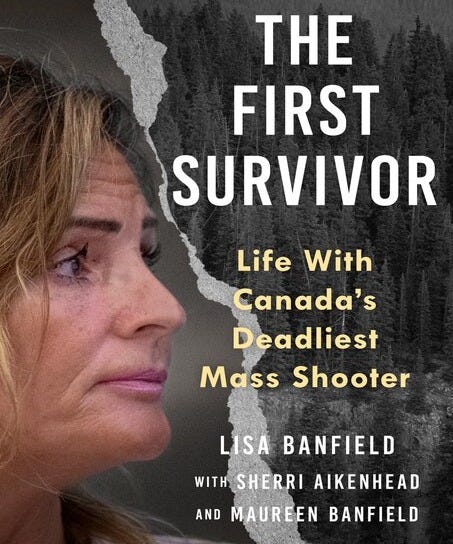
Lisa Banfield, common-law wife of the man who meticulously slaughtered 22 people six years ago, recently published a memoir of her life-on-eggshells with a controlling killer.
The First Survivor: Life with Canada’s Deadliest Mass Shooter (Sutherland House) is disturbing reading, though not for any fresh light it sheds on the gunman’s merciless rampage. That part of the horrific story has been told before.
Banfield was brutally attacked by her spouse on April 18, 2020, the night of the first murders in Portapique, N.S. She barely escaped, and hid in the frosty woods overnight, terrified and badly injured.
She emerged at dawn, hypothermic with a broken vertebra and cracked ribs. Soon she was in RCMP custody, even as the killer remained at large. She told officers everything, including vital information about his fake police vehicle used to dupe victims. Until that moment, the Mounties had inexplicably discounted every witness report about the bogus patrol car.
Banfield continued to spill information for days and months, and bravely testified at a public inquiry, facing hostile family members in the hyper-charged hearing room.
Most of her account has already appeared in the Mass Casualty Commission’s final report or in often-sensationalized news media reports. I included much of Banfield’s frank testimony in my 2023 book about the rampage and the botched police effort to stop the killer. (RCMP finally gunned him down after a chance encounter at a gas bar.)
What’s valuable and new in the memoir, at least to me, is Banfield’s recounting of the desolate years leading up to the slaughter, and her life-sapping grief in its aftermath.
We learn about Banfield’s oversized family in the Halifax suburb of Beaver Bank, presided over by a hard-working mother and slyly critical father, both of whom were alcoholics. As a babysitting teenager, Banfield was sexually assaulted by a neighbour, who had done the same to her sister Maureen. She belatedly told her parents. Her weak mum deferred to dad, who tersely shrugged it off, saying “Is that all?”
“I believed for the first time in my life that I didn’t matter,” Banfield writes. “My parents, my most cherished guardians, didn’t protect me.” Sisters Lisa, Maureen and Janice consequently clung one to the other, and stayed close through adulthood.
Banfield’s deep vulnerability made her an easy mark for a predatory man. Over a 19-year relationship, her partner coercively controlled her money, work, social life and family ties. He sold her car to make her dependent on him for transportation. He brutally assaulted her at least 10 times. On the few occasions police showed up, they did nothing. The cops were his buddies. He warned Banfield that if she ever left, he would hunt down and kill her family members. He collected an arsenal of unregistered guns to do the job.
Some bereaved families blamed Banfield for the killings, accusing her of enabling the murderer. RCMP charged her with helping the perp acquire ammunition, acknowledging she knew nothing about his intentions. (The charge, deflecting from Mountie failures, was resolved without a prosecution.) The families sued her.
In the years that followed, Banfield – vilified, at times verging on suicidal – was supported emotionally and financially by her steadfast, loving sisters. She ran up $75,000 in legal costs, with no income to pay the bills, which were also beyond the capacity of her sisters. A judicial settlement conference in 2024 finally sorted the lawsuit and various claims on the dead perp’s $2 million in assets, allowing Banfield to pay off her debts and secure a modest living.
Banfield says religious belief guided her through the darkness, but her sisters are the true saints. They held her hand through teenage sexual assaults, dysfunctional alcoholic parenting, a predatory narcissistic partner, the scorn of grieving relatives, the hot spotlight of a public inquiry and the grind of a wobbly justice system. Her instinct for survival saved her from a vicious murderer on April 18, 2020, but her memoir shows she has been fending off assaults for most of her life, long before and well after Portapique. Sisterhood has made all the difference.
I see you have swallowed the whole survivor narrative from Banfield. Anyone who gives it any thought must see the contradictions and questions from her “story” of the night and her time with Wortman.
How did she get out of the cuffs? How did she escape from the patrol car? How did she spend a night in the woods lightly dressed without any visible effect.
You also parrot the official RCMP narrative about the “chance encounter at a gas bar” that lead to Wortman’s execution. Wortman had to die lest he spill the beans on the RCMP involvement in his activities.