


Secrecy surrounding cabinet documents is so absolute in Canada that critics look to theology and astrophysics for metaphors to describe it.
Federal cabinet records in Canada are treated as “sacred artefacts to be shrouded in mystery for decades, hidden in a black hole beyond the contemplation of judges, commissioners, or citizens.”
That’s the concluding line in a new paper by the legal scholars Yan Campagnolo and Vincent Kazmierski. The professors from the University of Ottawa and Carleton University presented their findings to a Canadian Bar Association session last month.
Their lengthy paper makes compelling arguments that Section 69 of the Access to Information Act, which confers absolute secrecy on cabinet documents for 20 years after their creation, is in fact unconstitutional.
The professors review key legal cases, compare Canada’s secrecy regime with other Westminster-style governments, and probe the evolution of Section 69 to conclude that a constitutional court challenge could – and should – be launched.
Campagnolo is not aware of a current court application, but he and Kazmierski “are both available to provide our perspective and support for any challenge,” he told me.
As the law stands, cabinet records are completely immune from requests under the Access to Information Act for the first two decades. When a government official deems a document as falling under the Section 69 exclusion, that’s pretty much the end of the story.
Canada’s information commissioner, an officer of Parliament, cannot independently review the decision or even inspect the withheld material. Similarly, the courts have no authority to conduct their own review. The records remain hermetically sealed.
Campagnolo has explored this problem previously, notably in his 2021 book Behind Closed Doors: The Law and Politics of Cabinet Secrecy. The new paper with Kazmierski, to be published this summer in the McGill Law Journal (citation below) expands the analysis, and urges limits to Canada’s cabinet secrecy while acknowledging that some records must be withheld to safeguard the collective decision-making process of cabinet.
The paper is keyed to two sections of the Canadian Charter of Rights and Freedoms, referring to fundamental freedoms and democratic rights. The analysis can be taxing for non-legal minds (mine), but some elements ring true to experience.
I’ve been refused access-to-info documents thousands of times because they’ve been rubber-stamped as cabinet confidences, under Section 69. I can’t complain to anyone about these refusals, neither the information commissioner nor the courts. The diktats simply can’t be challenged under the law.
Which raises the question: is this unfettered power of bureaucrats to declare documents as cabinet secrets being abused? From my requester perspective, the circle of documents trapped inside this black hole seems to grow wider every year. Are public servants who review my requests ever more inclined to label records as cabinet confidences, safe in the knowledge that their decisions won’t be second-guessed?
The Campagnolo-Kazmierski paper offers evidence that something dubious is indeed going on.
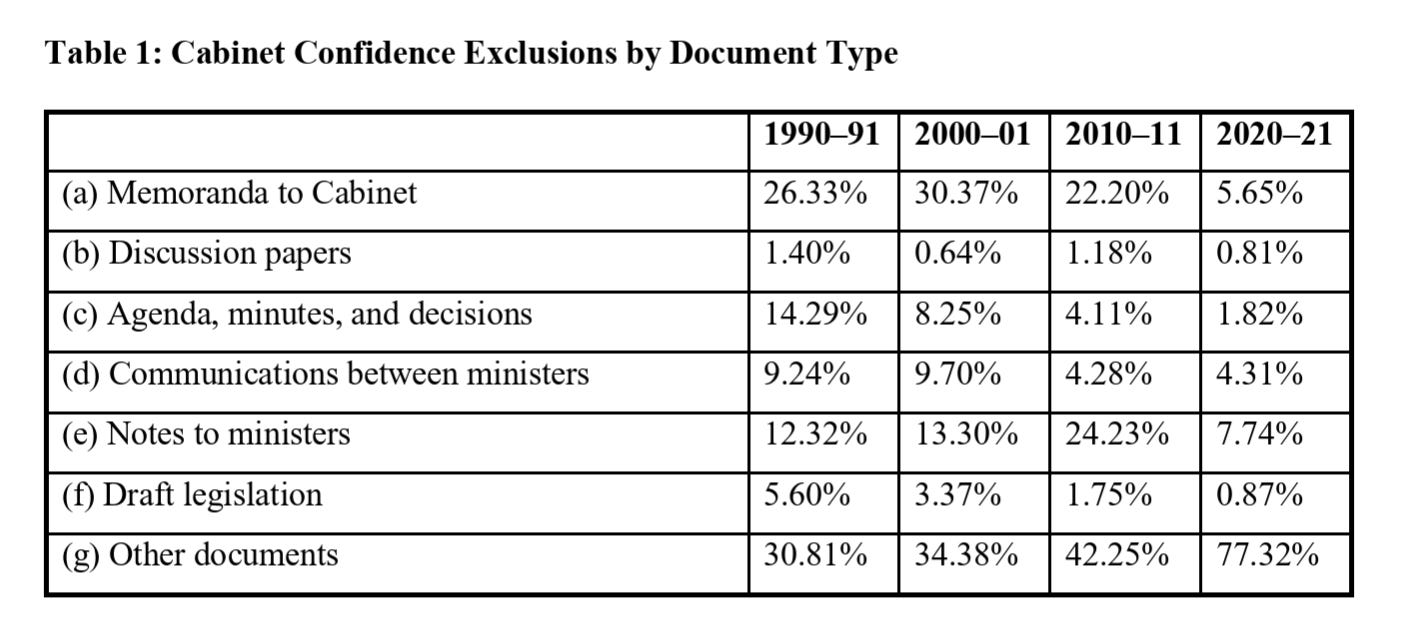
The authors include a statistical table showing that in the three decades between 1990-91 and 2020-21, the government officials increasingly labelled emails and other commonplace records as cabinet confidences when responding to access-to-information requests. Use of this exclusion for these low-level records rose from 30.81 per cent of all exclusions, to 77.32 per cent over the 30-year period.
“These data suggest that the types of documents excluded under section 69 have shifted over the years from official Cabinet documents to other government documents, such as emails and other departmental records, that are only remotely connected to the collective decision-making process,” the authors observe.
So the circle of secrecy does appear to be widening, like the maw of a voracious black hole.
Advocates of transparency have long called for reform of cabinet secrecy in order to restore accountability, while accepting that some cabinet confidences can be legitimately withheld. I reiterated this challenge in a recent brief for the government’s current review of the Access to information Act, available here:

Two legal scholars have added their voices, arguing the law offends the Canadian Constitution.
Governments in Ottawa clearly benefit from the unassailable fortress that insulates purported cabinet records from public scrutiny or review. So the job of reform likely falls to the courts – and to civic-minded individuals or organizations willing to take on the Charter challenge.
___
Yan Campagnolo & Vincent Kazmierski, “Secret, Not Sacred: Constitutional Limitations on the Protection of Cabinet Confidences under the Access to Information Act” (2026) 71:3 McGill LJ (forthcoming)